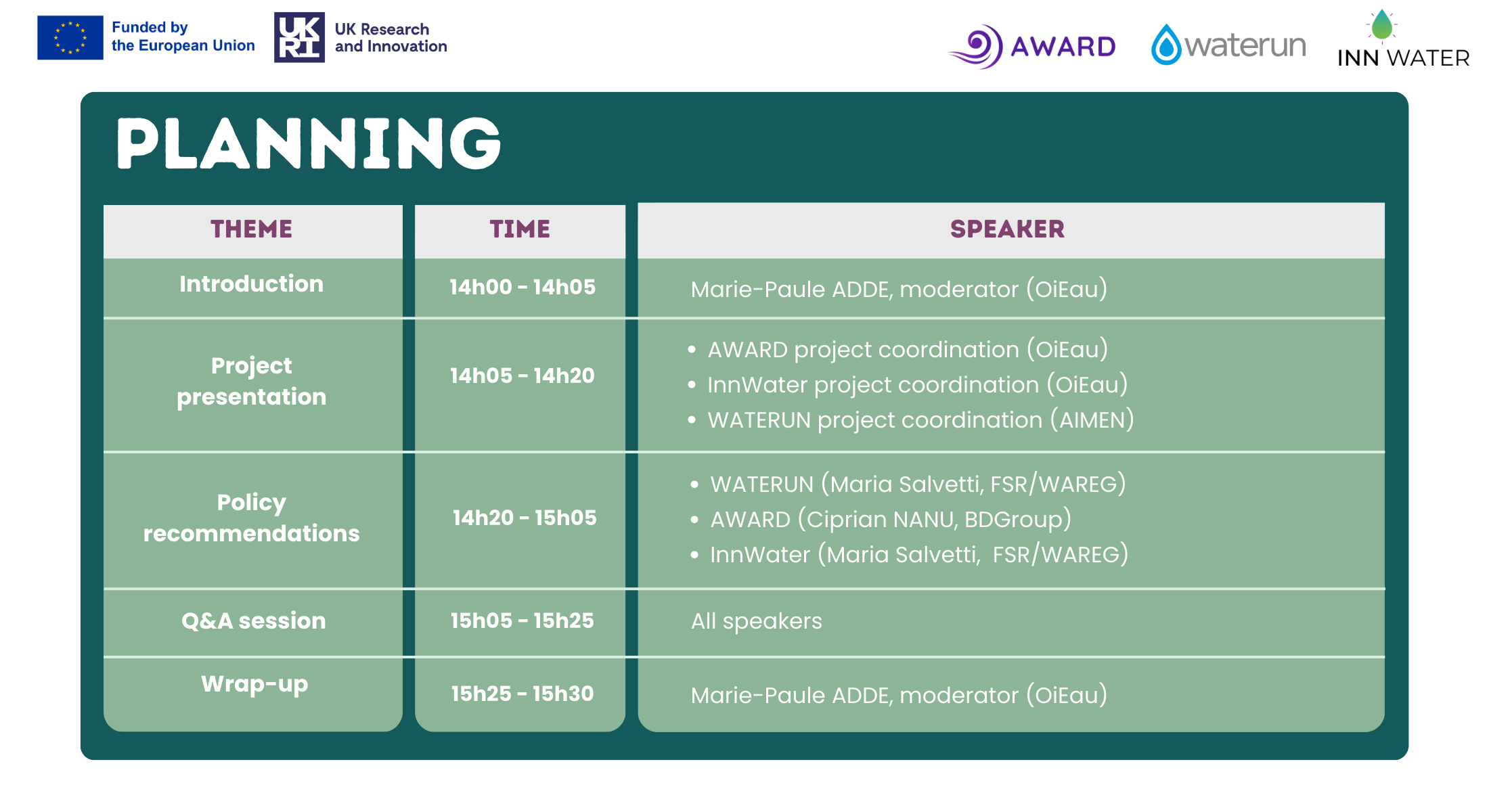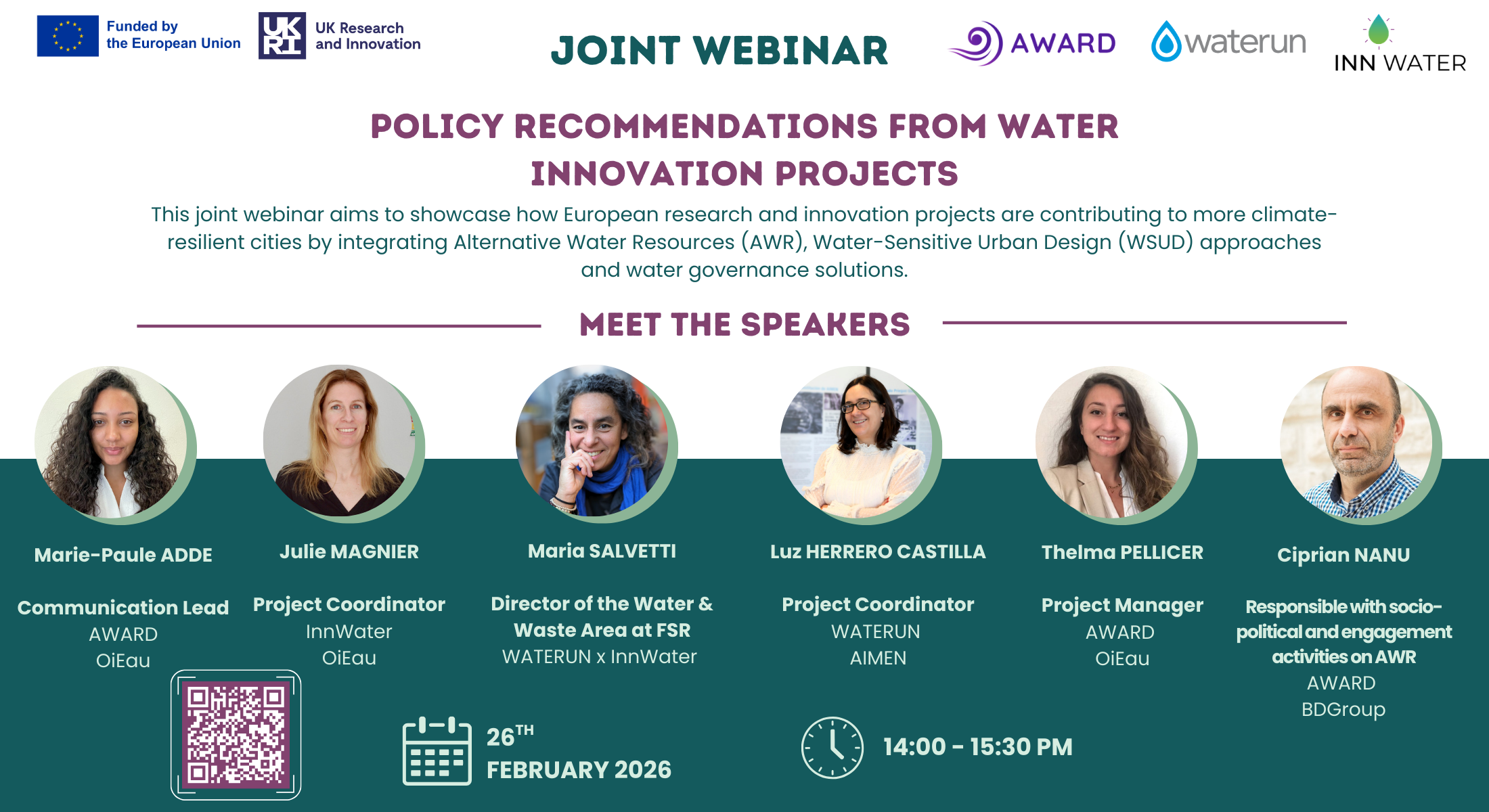
On 26 February 2026, the Horizon Europe projects AWARD, InnWater and WATERUN organised a joint webinar entitled “Policy recommendations from water innovation projects.” The online event brought together researchers, policy experts and water practitioners to discuss how innovation, governance frameworks and citizen engagement can contribute to more resilient water systems across Europe.
The webinar provided an opportunity to present key results and policy recommendations developed within the three projects, highlighting complementary approaches to addressing water scarcity, pollution and governance challenges.
Integrating alternative water resources into strategic planning
The AWARD project focuses on the integration of Alternative Water Resources (AWR) into strategic water supply planning. By combining technological innovation with governance and social engagement approaches, the project aims to demonstrate how solutions such as rainwater harvesting, water reuse and aquifer recharge can support climate-resilient water management.
During the webinar, AWARD partners presented results from a cross-country analysis examining public awareness and perception of alternative water resources. The findings revealed that while awareness of global water challenges is generally high, knowledge about innovative water solutions remains limited, and institutional communication on these topics is often insufficient.
Among the key recommendations discussed were the integration of water literacy into environmental education, the development of accessible information platforms for citizens, and the organisation of local water forums to strengthen dialogue between stakeholders and communities.
Strengthening water governance through practical assessment tools
The InnWater project focuses on improving sustainable and inclusive water governance across Europe through social innovation and multi-level collaboration.
During the webinar, InnWater partners presented the project’s governance assessment framework and practical Water Governance Assessment Tool, which supports practitioners and decision-makers in evaluating and strengthening water governance systems. The framework builds on the OECD Principles on Water Governance and includes key dimensions such as institutional roles and responsibilities, financing mechanisms, environmental resilience and stakeholder participation.
These tools have been developed and tested through collaboration with stakeholders in several pilot sites, helping local and regional authorities assess governance arrangements and identify opportunities to improve coordination, inclusiveness and long-term resilience in water management.
Addressing urban runoff pollution through innovative monitoring and planning tools
The WATERUN project addresses the challenge of urban runoff pollution, which carries contaminants such as nutrients, heavy metals, pathogens and microplastics from urban surfaces into water bodies.
The project develops innovative monitoring solutions, modelling tools and decision-support systems designed to help cities identify pollution sources and plan mitigation strategies. These tools are complemented by nature-based and blue-green infrastructure solutions aimed at reducing runoff, improving infiltration and strengthening urban water resilience.
Case studies in cities such as Aarhus, Santiago de Compostela and Amman demonstrate how combining monitoring technologies, modelling tools and stakeholder collaboration can support more effective management of urban runoff and diffuse pollution.
Strengthening collaboration between European water innovation projects
The webinar highlighted the strong complementarities between the three projects. While AWARD focuses on alternative water resources and social acceptance, InnWater addresses governance structures and stakeholder participation, and WATERUN develops technical and regulatory solutions for urban runoff management.
By sharing policy recommendations and project results, the initiatives aim to support policymakers, practitioners and local stakeholders in adopting innovative approaches to water management and strengthening resilience to climate change.
The discussion concluded with a call for continued collaboration between European research projects, institutions and local actors to accelerate the transition towards sustainable and resilient water systems.